Does My Business Website Need a Redesign? 8 Signs to Look For
Most business owners don’t decide on a website redesign out of nowhere. Instead, something starts to nag at them. A customer mentions the site is hard to use on a phone. A competitor’s site suddenly looks sharper. Or the phone just isn’t ringing the way it used to.
A redesign isn’t always the answer. Sometimes a few targeted fixes do the job for far less money. Still, there are clear signs that patching an old site has stopped making sense. Here are eight we look for when a business owner asks us whether it’s time.
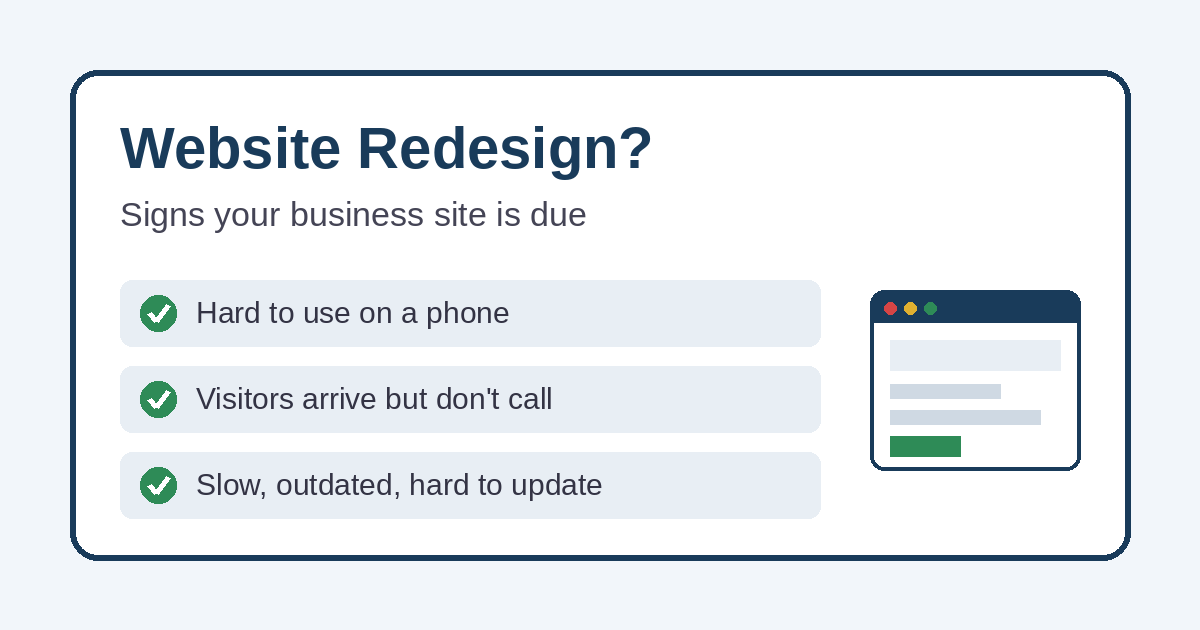
1. Your website is hard to use on a phone
Pull up your own site on your phone and try to do what a customer would do. Find your hours. Tap your phone number. Fill out the contact form. If you have to pinch, zoom, or hunt, your visitors are struggling too.
Plenty of people look up local businesses on their phones, often in a hurry. So a site built for desktop screens years ago can quietly turn them away. Google also uses the mobile version of a site for indexing, as its mobile-first indexing guide explains. In short, a layout that adjusts to any screen is now a basic expectation.
2. It looks dated next to your competitors
Design trends come and go, so “old” isn’t a problem by itself. The real question is what the site says about you at first glance. Cramped text, tiny photos, tired stock images, and cluttered menus can make a solid company look less established than it is.
Try a simple test. Search for your main service and open the top few local results. Then open yours. If you wouldn’t pick yourself based on the website alone, that’s worth paying attention to.
3. Visitors arrive, but they don’t call or fill out the form
Traffic without inquiries usually points to a clarity problem. For example, visitors can’t quickly tell what you do, where you work, or how to reach you. We covered the common causes in why a website isn’t generating phone calls.
If those fixes touch nearly every page, a website redesign is often cleaner than rewriting one section at a time.
4. It’s slow, and the speed fixes don’t stick
Many speed problems can be solved with image compression, caching, or better hosting. You can get a quick read on your own site with Google’s free PageSpeed Insights tool.
However, some older sites are slow because of how they were built. Heavy page builders, piles of plugins, or an abandoned theme can drag every page down. If you speed the site up and it bogs down again a few months later, the foundation may be the real issue. It also helps to know what your website hosting actually includes, since hosting and the website itself solve different problems.
5. You can’t update it yourself, or you’re afraid to
Changing a phone number shouldn’t mean emailing a developer and waiting a week. The same goes for owners who avoid logging in because something broke the last time they tried.
A modern WordPress site can be set up so everyday edits are simple and safe. As a result, your hours, services, and specials stay current without a support ticket.
6. Outdated plugins can force a website redesign
Older WordPress themes and plugins sometimes stop receiving updates. When that happens, you’re left with two bad choices. You can keep running outdated code, or you can update and hope nothing breaks.
Neither choice is great, especially for security. Our guide to protecting your website from hackers explains why unpatched software is a common way in. So if key parts of the site can no longer be updated safely, that’s one of the strongest reasons to rebuild.
7. Your business changed, but the site didn’t
Maybe you added a service, dropped one, moved, or started serving more communities. Maybe the site still lists staff who left years ago. When the website describes the business you used to be, customers get mixed signals.
This matters for local search too. Your website and Google Business Profile should match, because mismatched details make both look less trustworthy.
8. Your search visibility has slipped
Rankings move for many reasons, and a redesign won’t guarantee a better spot on Google. That said, some older sites have structural issues that hold them back. There may be missing page titles, one long page trying to cover every service, or no clear page for each area you serve.
When the fix means reorganizing the whole site, a website redesign lets you plan the structure properly instead of bolting on pages.
When a refresh beats a full website redesign
Not every sign on this list calls for starting over. If the design still holds up and the site runs on current, supported software, a refresh may be the smarter move. New photos, rewritten service pages, a clearer homepage, and faster hosting can go a long way.
On the other hand, a rebuild usually makes sense when several of these signs show up at once. It also makes sense when the site’s foundation can’t be updated safely.
What a good website redesign should keep
A new site shouldn’t throw away what’s already working. Before anything changes, note which pages bring in visitors and which ones lead to calls or form submissions. Then make sure any page that moves gets a redirect to its new address, so visitors and search engines don’t hit dead ends.
Your domain, your best-performing content, and your business email should also carry over without drama. A careful plan up front keeps the switch from costing you the visibility you’ve already earned.
Not sure your website needs a redesign?
Simplified Internet Design builds and rebuilds websites for small businesses, nonprofits, and local governments across St. Clair County and Southeast Michigan. You can browse past projects in our portfolio or read more about our website design services.
If you’d like a straight answer about whether your site needs a rebuild or just a tune-up, send us a note and we’ll take a look.