Who Should Build Your Website? DIY, AI Builder, Freelancer, or Local Team
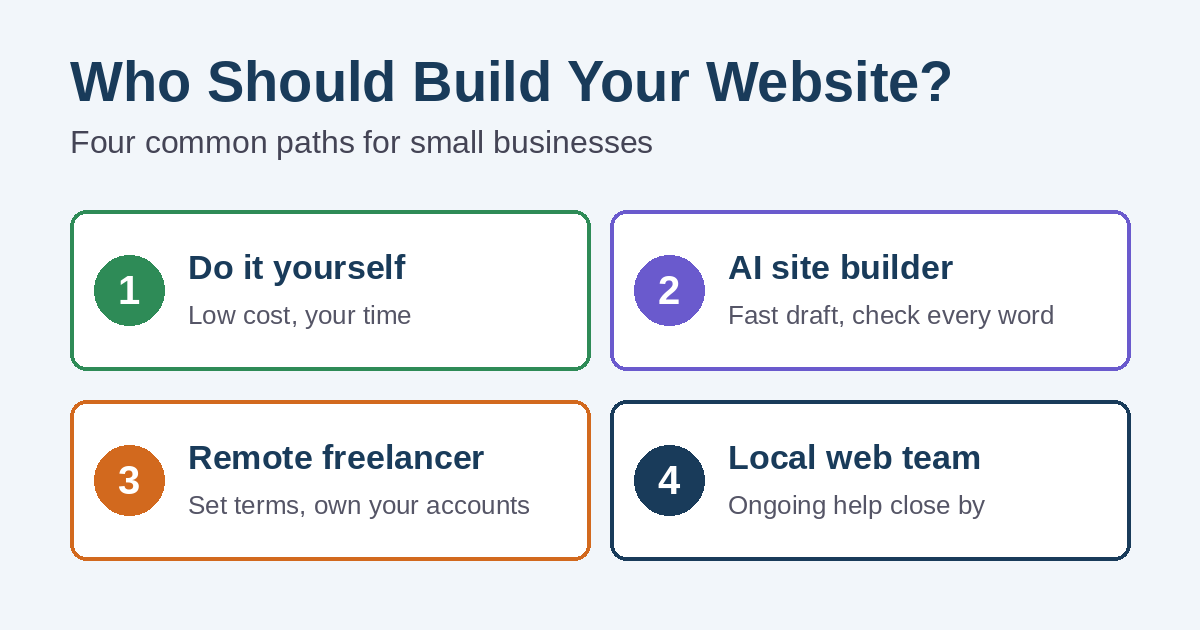
If you own a small business, sooner or later you have to decide who should build your website. Maybe you’re starting from scratch, or maybe the current site is tired and the person who made it has moved on. Either way, you’ve probably seen four main paths: build it yourself, let an AI builder generate it, hire a freelancer online (often overseas), or work with a local web design team.
Each option can be the right call for a certain business. The trouble starts when the choice is based only on the upfront price. Below is an honest look at what each path gives you, where it tends to fall short, and the questions that matter no matter who you hire.
Who should build your website: what you’re really deciding
A website isn’t a one-time purchase. After launch, someone has to keep it updated, secure, backed up, and accurate. Someone also has to answer the question “why isn’t the contact form working?” at an inconvenient moment.
So when you ask who should build your website, you’re also asking who will look after it. You’re deciding who holds the keys to your domain and hosting, too. Keep that in mind as you compare the options.
Option 1: Build it yourself with a website builder
Drag-and-drop builders let you build your website from a template, swap in your text and photos, and go live without hiring anyone. For a brand-new business with a tight budget, that can be a sensible first step.
Where DIY works well
- You need a simple site with a few pages: home, services, about, and contact
- You enjoy this kind of work and have time to learn the tool
- You’re testing an idea before investing more
Where DIY gets harder
The building part is usually the easy part. Writing clear service descriptions, taking good photos, setting up page titles for search, and making the site load fast on a phone take more time than most owners expect. In addition, many builders keep your site on their own platform. If you outgrow it later, moving to something else can mean starting over.
The biggest hidden cost is your time. Hours spent fighting with layouts are hours you’re not spending on customers.
Option 2: An AI website builder
AI builders ask a few questions about your business and generate a full site in minutes, complete with headlines, page text, and stock images. It’s an impressive shortcut, and it can give you a working draft faster than anything else on this list.
What to watch for with AI-generated sites
The draft is only as good as what you feed it. AI tools don’t know your service area, your pricing, your licenses, or what makes you different from the shop down the road, so the text often comes out generic. Sometimes it even states things that aren’t true about your business. Every sentence needs a careful read before it goes live.
Google has said that it focuses on the quality of content rather than how it was produced. That cuts both ways. AI-written pages aren’t penalized just for being AI-written, but thin, look-alike pages won’t earn you much either. Finally, an AI builder still leaves you as the person responsible for updates, security, and fixing things when they break.
Option 3: An overseas or online freelancer
Freelance marketplaces make it easy to hire someone anywhere in the world to build your website, often at a lower hourly rate. Plenty of skilled people work this way, and some businesses get great results.
Common risks with a remote freelancer
- Account ownership: the domain, hosting, or theme license may end up in the freelancer’s name instead of yours
- Handoff: if the project ends abruptly, you may not get admin logins or a backup of the site
- Time zones: a broken form on a Monday morning might not get looked at until the next day
- Local knowledge: someone far away won’t know your towns, your customers, or how people around here search
- After launch: many freelancers move on to the next project, so ongoing care is up to you
None of these are deal-breakers if you set clear terms up front. The questions later in this article will help.
Option 4: A local web design team
A local team is usually the most expensive option upfront compared with doing it yourself. In return, you get people who can meet with you, learn how your business works, and stay involved after launch.
What a local team can offer
A good local team will build your website around your real services and the communities you serve. They can also handle the pieces that tend to fall through the cracks, such as hosting, backups, security updates, and making sure your website and Google Business Profile tell the same story. When something goes wrong, you call someone you know.
Local doesn’t automatically mean good
Being nearby is a convenience, not a guarantee. Look at sites a company has actually built, ask how they handle ownership and updates, and make sure the price is clear before work starts. If a local firm can’t answer those questions plainly, keep looking.
Questions to ask before deciding who should build your website
Whichever path you lean toward, these questions separate a smooth project from a painful one:
- Will the domain name and hosting account be registered in my business’s name?
- Will I get my own administrator login to the website?
- Who writes the page content, and who checks it for accuracy?
- What happens after launch? Who handles updates, backups, and security?
- How are future changes priced, and how quickly are they done?
- Can I see websites you’ve built, and are those sites still working well?
- If we stop working together, how do I get a full copy of my site?
The first two questions matter most. ICANN, the group that oversees domain names, outlines the rights of domain name registrants, and those rights belong to whoever is listed as the registrant. If that isn’t you, your web address isn’t fully yours.
Who should build your website? Which option fits your business
The right choice depends on your budget, your time, and how much you want the website to do for you. Here’s a quick way to think it through:
- DIY builder: a brand-new business with a simple message, a very small budget, and time to learn
- AI builder: someone who wants a fast first draft and is willing to rewrite and fact-check every page
- Remote freelancer: a business that can write a clear project scope and keeps ownership of every account
- Local team: a business that wants the website to bring in calls and leads, and would rather have someone else handle the technical side long-term
It also helps to look at the full picture of what you’ll pay over time, not just the build. Our website and marketing costs checkup walks through hosting, domains, care plans, and the other bills that show up after launch. If you already have a site and aren’t sure whether to start over, these signs your website needs a redesign can help you decide.
Who should build your website? Talk it over with a St. Clair County team
Simplified Internet Design builds and looks after websites for small businesses, nonprofits, and local governments in St. Clair County and Southeast Michigan. You can browse websites we’ve built or read about our website design services.
Still weighing your options? Contact us and we’ll give you a straight answer about which path makes sense for your business, even if it isn’t us.